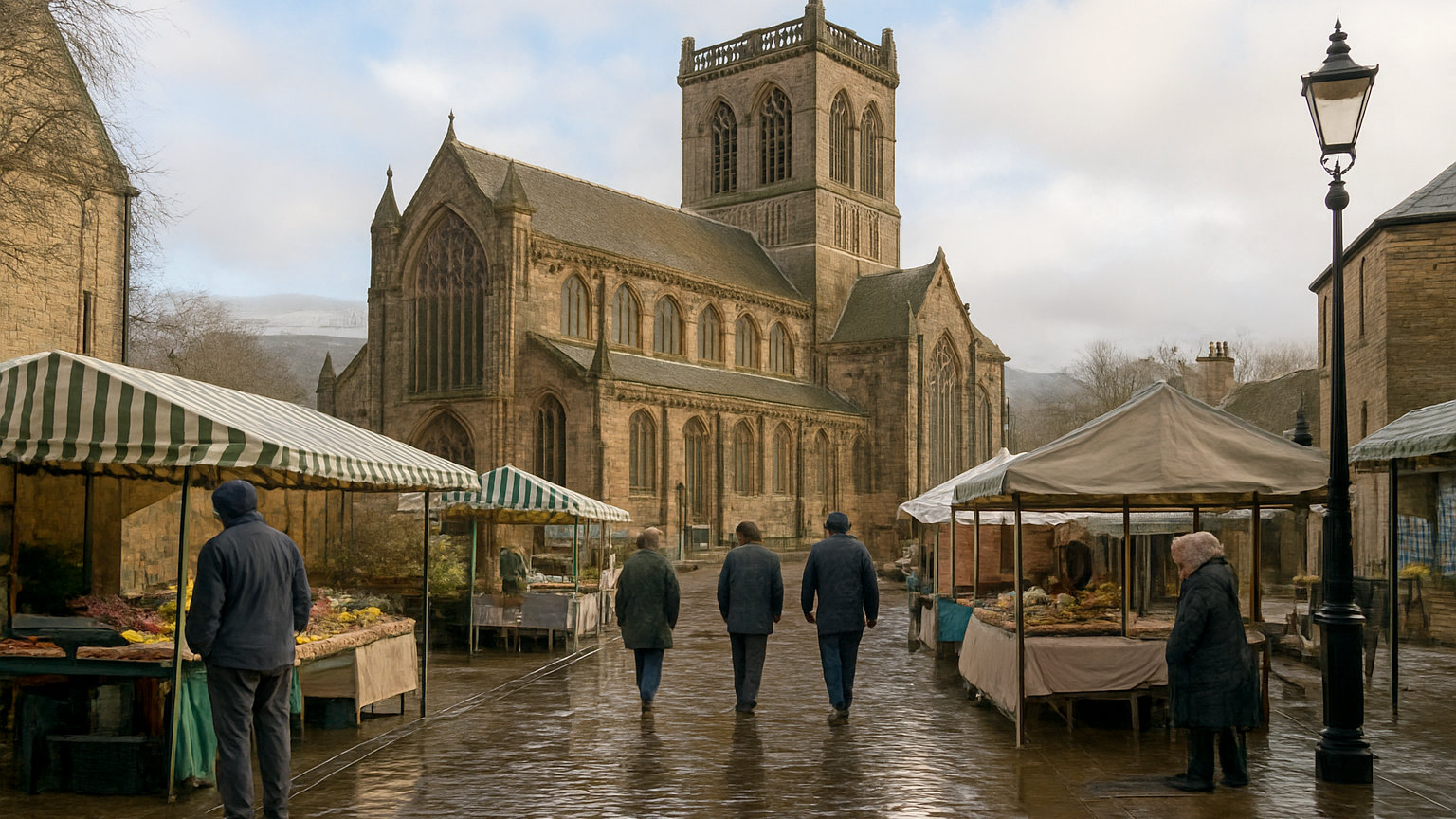
Glasgow Cathedral is the only medieval cathedral on the Scottish mainland to have survived the reformation with its roof intact, which makes it exceptional. Elsewhere in Scotland the great churches were abandoned and became the ruins at Elgin and St Andrews.
Why did it survive?
Because the city's trade guilds and citizens defended it, and because it was retained for parish worship rather than left without a use.
For a period after the reformation it was divided internally into three separate congregations, which preserved the fabric even though it damaged the interior arrangement.
What is the lower church?
A vaulted space beneath the eastern end, built to house the tomb of the city's patron saint on ground that sloped away, so it is a full storey rather than a conventional crypt.
It is generally regarded as the finest medieval interior in Scotland, a forest of clustered piers and ribs around the shrine at its centre.
Who was Mungo?
Also called Kentigern, a sixth century missionary traditionally regarded as the founder of Glasgow, whose tomb is the reason the cathedral stands where it does.
The city's coat of arms records four miracles attributed to him, and a local rhyme about a bird, a tree, a bell and a fish refers to them.
What is the Blacader Aisle?
A small vaulted chapel added at the south of the lower church around 1500, with painted bosses and a lightness quite unlike the rest of the building.
It was probably intended as the start of a larger scheme that was never completed.
What is above?
A long thirteenth century choir and nave, with a fifteenth century stone screen separating them, which is the only surviving medieval choir screen in any Scottish church.
The timber roof over the nave retains a substantial amount of medieval work.
What about the glass?
Almost entirely modern, since the medieval glass did not survive, and it forms one of the largest collections of post war stained glass in Britain.
The Millennium Window and the west window are the most striking, and the whole scheme was commissioned across several decades.
What is the Necropolis?
A Victorian cemetery on the hill directly behind the cathedral, laid out from 1832, with several thousand monuments including work by significant architects.
It is free to walk, gives the best view of the cathedral and the city, and is among the more atmospheric places in Glasgow.
What is opposite?
Provand's Lordship, built in 1471 and the oldest house in Glasgow, and the St Mungo Museum of Religious Life and Art, both free.
The three together make a straightforward morning and cover a good deal of the city's early history.
Does it charge?
No. Entry is free. The building is owned by the Crown and cared for by the national heritage body, while the congregation of the Church of Scotland worships in it.
That arrangement is unusual and reflects the way Scottish church property was handled after the reformation.
What should you know before visiting?
Opening hours are shorter in winter and the cathedral closes for services and events. The lower church is cold and the stairs are worn.
It sits east of the city centre near the royal infirmary, around twenty minutes on foot from George Square.
How does it compare with Kirkwall?
St Magnus Cathedral in Orkney also survived complete, founded by Norse earls in red and yellow sandstone, and is the other great medieval survival in Scotland.
The two are very different and both are worth the journey.
What should you look for in the lower church?
The bosses on the vaults, the well associated with the saint, and the way the piers are arranged around the tomb to create a processional route for pilgrims. It is dimly lit by design, and giving your eyes a few minutes to adjust before moving around is worth doing.
One final point: the cathedral, Provand's Lordship, the museum and the Necropolis are all free and sit within a few minutes of each other, which makes this the cheapest and most historically dense morning available anywhere in Glasgow.