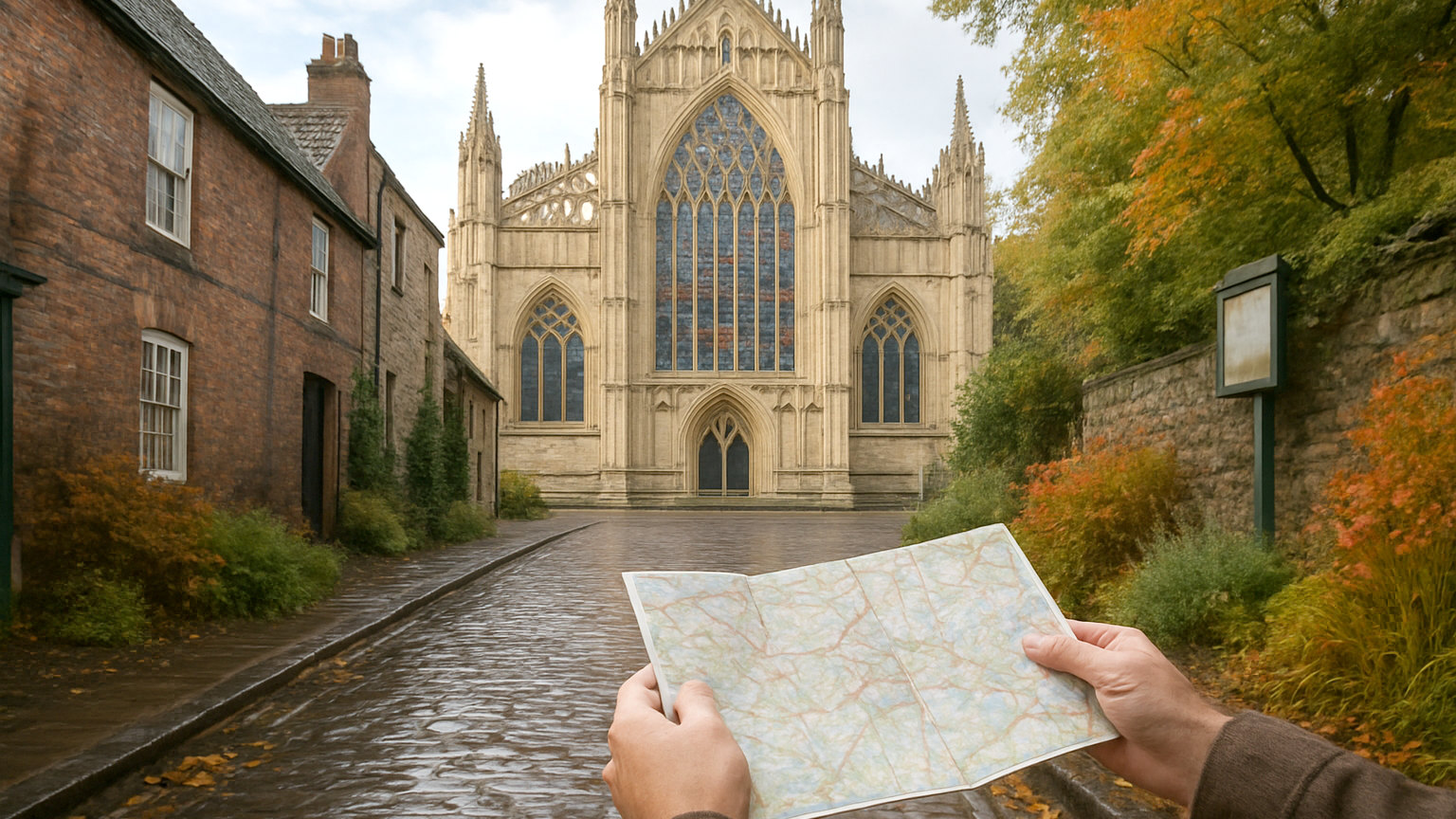
Medieval stained glass is among the great achievements of European art and Britain lost the overwhelming majority of it. What survives is concentrated in a small number of buildings, and York alone holds a substantial share of everything left in England.
Why was so much destroyed?
Two waves. The reformation in the sixteenth century removed imagery considered idolatrous, and the civil war and the period after it saw further systematic destruction by iconoclasts.
Later, glass was lost through neglect, storm damage and Victorian restoration that replaced medieval work with modern imitation.
Why did York keep so much?
Partly local resistance, partly distance from the centres of iconoclasm, and partly straightforward luck.
York Minster now holds around half of all the surviving medieval stained glass in England, which makes it the single most important building for it in the country.
What is the Great East Window?
A window at York roughly the size of a tennis court, glazed in the early fifteenth century by a single master glazier under contract, depicting the beginning and end of the world.
It is the largest expanse of medieval stained glass in a single window anywhere, and it was fully conserved and reinstalled in recent years.
What are the Five Sisters?
Five tall lancet windows at York glazed in grisaille, a grey and green geometric patterning rather than pictorial imagery, dating from the thirteenth century.
They are the largest surviving grisaille windows in the world and are quite unlike the coloured glass around them.
What is at Canterbury?
Some of the oldest glass in England, including panels from the twelfth century, and a series of windows depicting the ancestors of Christ that are among the earliest surviving anywhere.
The miracle windows recording cures attributed to Becket are extraordinary as historical documents as well as art.
Where else survives?
Gloucester's east window, made in the mid fourteenth century and among the largest medieval windows in Britain. Wells has a Jesse window of exceptional quality.
Lincoln's rose windows, Tewkesbury Abbey and Malvern Priory all retain significant medieval glass.
What about parish churches?
One holds the finest complete set in the country. Fairford in Gloucestershire has its entire original scheme of twenty eight windows intact, which survives nowhere else in England.
It is a village church, free to enter, and is worth travelling for on its own account.
How did wartime affect it?
Positively, unexpectedly. Glass at York, Canterbury and elsewhere was removed and stored for safety during the Second World War.
Buildings were damaged and the glass survived. Canterbury's removal is credited with saving windows that would otherwise have been lost to bomb blast.
How do you actually look at it?
With binoculars, which transform the experience since most windows are far above eye level and the detail is small.
Several cathedrals provide them or offer mirror trolleys. Bright overcast light shows colour better than direct sun.
When is the light best?
East windows in the morning and west windows in the late afternoon, which is obvious once stated and rarely planned for.
Winter low sun through a south facing window throws colour across the stone floor, which is the effect the glaziers were working towards.
What is being done to preserve it?
Cathedrals employ specialist glaziers and run long conservation programmes, and several have opened workshops or exhibitions explaining the work.
York's programme in particular has been running for decades and visitors can sometimes see panels being conserved.
What about Scotland and Wales?
Very little medieval glass survives in Scotland, since the reformation there was more thorough, though fragments remain at a handful of sites. Wales lost most of its glass too, with the outstanding survival being at Gresford near Wrexham, a parish church holding a substantial medieval scheme.
One final suggestion: several cathedrals now display individual panels at eye level while conservation work is under way, which is the only realistic chance most visitors get to see medieval glass close up.