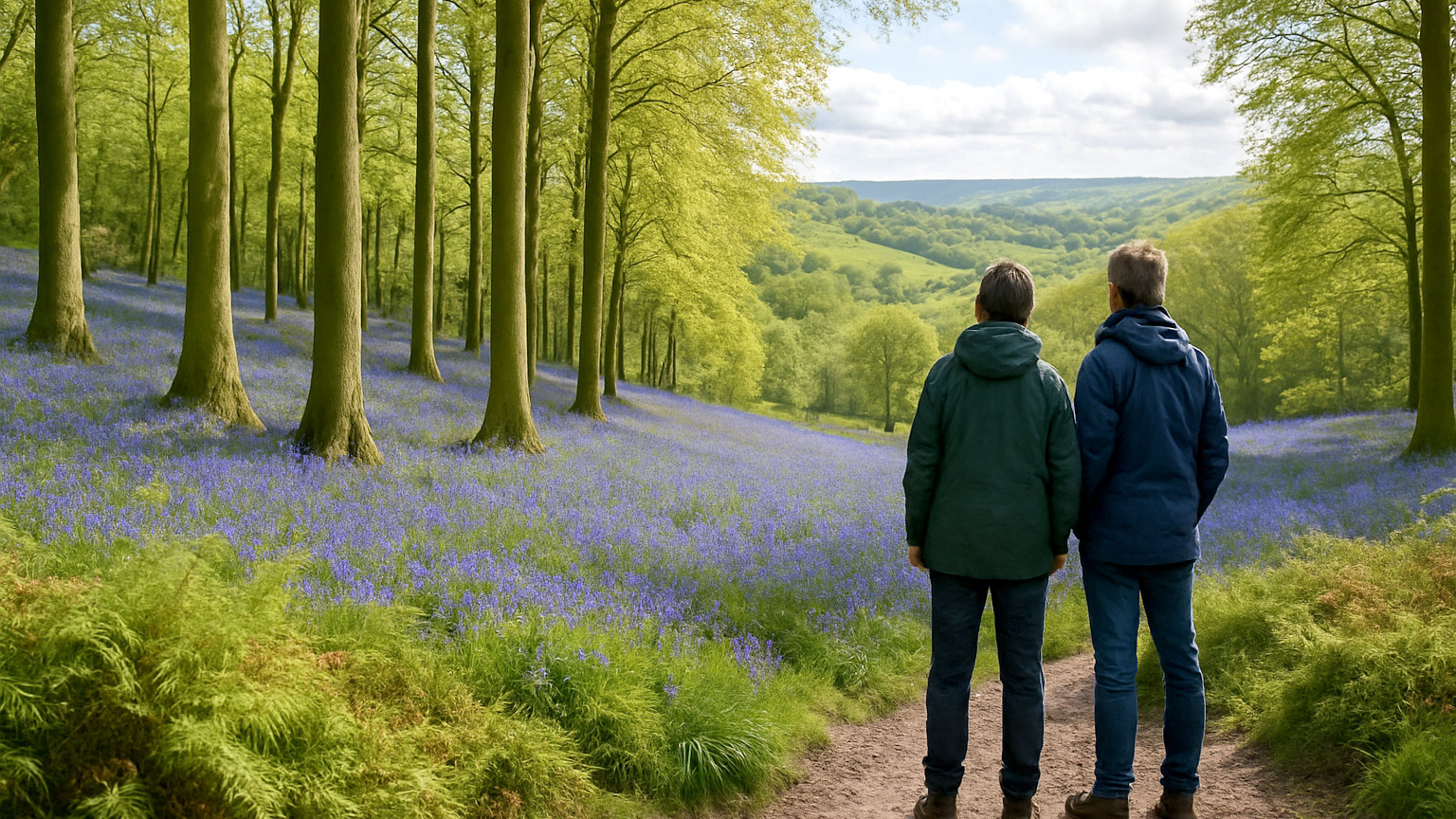
Britain holds something approaching half the world's bluebells, and a carpeted ancient wood in late April is among the finest sights in these islands. The season is short, the peak moves with the weather, and the flowers are considerably more fragile than they look.
When do they flower?
From mid April to mid May in most of England and Wales, later in the north and in Scotland. The peak in any given wood lasts roughly two weeks.
The exact timing shifts by a fortnight either way depending on the spring. A mild winter and warm March brings them early; a cold spring delays them. Several conservation organisations publish updates through April, which is the reliable way to time a visit.
Why are they associated with ancient woodland?
Bluebells spread slowly, largely by seed and bulb division, so a dense carpet takes a very long time to establish. They are therefore used as an indicator species for ancient woodland, meaning ground continuously wooded for several centuries.
A wood full of bluebells is usually old, and that is part of why these places matter beyond their appearance in April.
Where are the best woods?
The Chilterns, with Ashridge and Dockey Wood among the best known. Micheldever Wood in Hampshire. The Blean woods in Kent and Hole Park nearby.
In the west, the woods of the Wye Valley and the Forest of Dean. In Wales, Coed Cefn and the woods above the Usk. In Scotland, the oakwoods of Argyll. Blickling in Norfolk and Coton Manor in Northamptonshire are also outstanding.
What is the difference between native and Spanish bluebells?
Native bluebells have narrow drooping flower spikes with the bells hanging to one side, strongly recurved petal tips, a sweet scent and cream coloured pollen.
Spanish bluebells, introduced as a garden plant, stand upright with flowers all round the stem, have little scent and blue pollen. They hybridise readily with natives, which is the main long term threat to the wild population, so garden bluebells should not be planted near woodland or dumped in it.
Why should you stay on the paths?
Because trampling kills them. A bluebell crushed underfoot cannot photosynthesise and the bulb may not recover, and a wood can take years to recover from a single busy season of people walking into the carpet for photographs.
This is the single most important thing to know about visiting bluebell woods, and the damage at popular sites is visible and increasing.
Is it illegal to pick them?
Digging up wild bluebell bulbs is illegal, and picking flowers on land without the owner's permission is also an offence. Trading in wild native bluebell bulbs is prohibited.
Beyond the law, a picked bluebell wilts within hours and produces no seed. There is no good reason to take one.
When during the day is best?
Early morning and evening, both for the light and because the popular woods become crowded by mid morning at the peak weekend.
Overcast conditions photograph better than bright sun, which blows out the colour and produces harsh shadows through the canopy. Bluebells also appear more blue in soft light.
What else is out at the same time?
Wild garlic, which frequently grows alongside and smells unmistakable. Wood anemone slightly earlier, greater stitchwort and early purple orchid at the same time.
The dawn chorus is also at its peak in late April and early May, so an early bluebell visit gives you both at once.
How busy do they get?
The well known woods are very busy at the peak weekend, with car parks full by mid morning. Several sites now manage access or ask for advance booking during bluebell season.
The alternative is to find a smaller wood locally. Bluebells are widespread and most counties have several dozen good woods that appear in no guide at all.
One last suggestion: seek out a wood nobody writes about. Bluebells are widespread and most counties hold dozens of good woods with no car park, no signage and no visitors. A local ancient wood found on a map will frequently give you the same display in complete solitude, which the famous sites cannot.