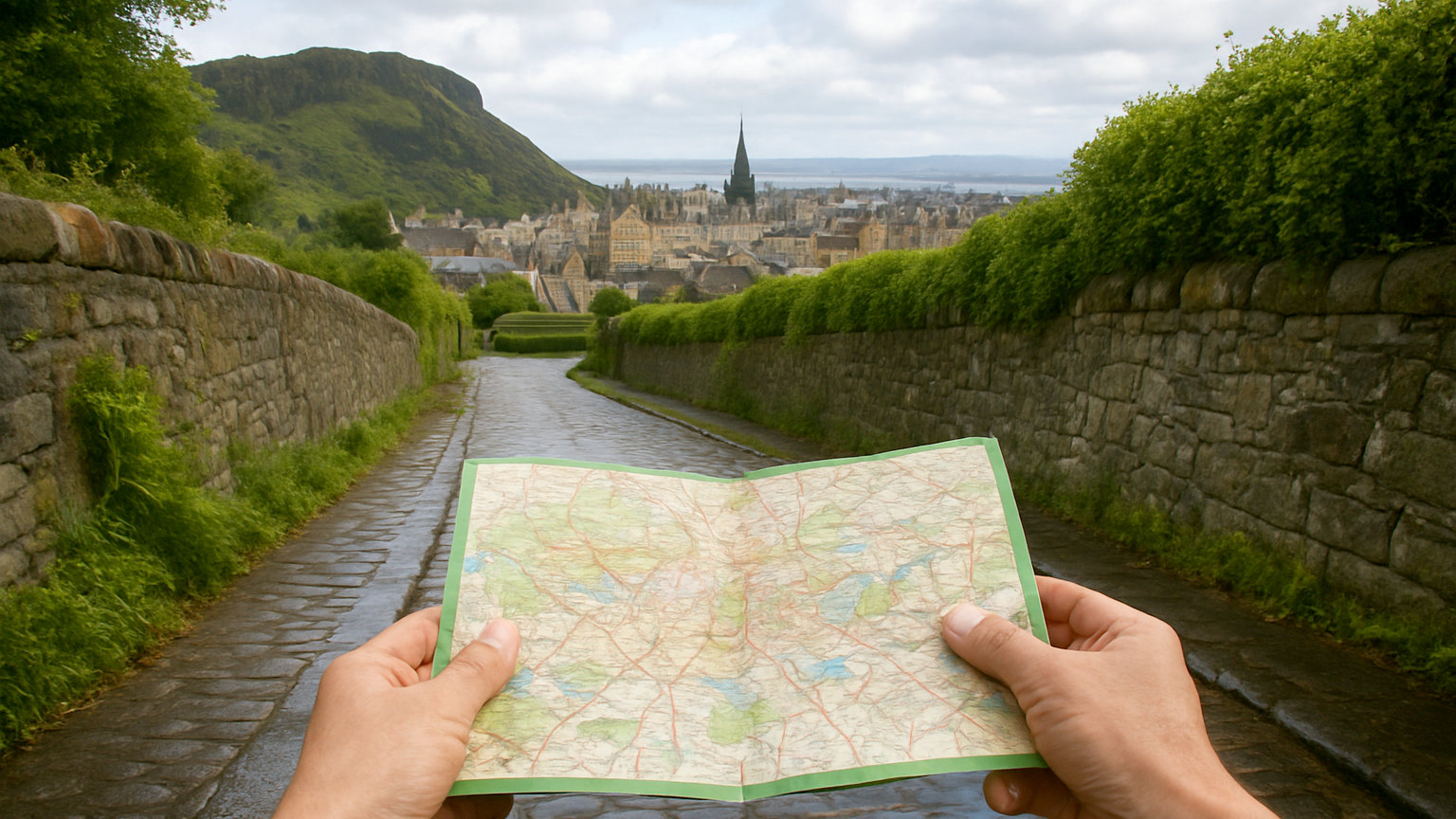
Edinburgh is built on the remains of a volcano and is divided into two entirely different halves: a medieval old town crammed onto a ridge below the castle, and a Georgian new town laid out in grids below it. Together they form a World Heritage Site and one of the most striking city centres in Europe.
What should you see first?
The Royal Mile, running from the castle down to the palace at Holyrood, with narrow closes and wynds dropping steeply off both sides. The closes are the interesting part and most visitors walk straight past them.
The castle itself sits on the plug of the volcano and holds the Scottish crown jewels and a stone of considerable constitutional significance. Book ahead, since it is among the most visited attractions in Britain.
What is the New Town?
A planned Georgian expansion begun in the eighteenth century, with wide streets, squares and crescents built to a coherent plan, and one of the largest and most complete Georgian townscapes anywhere.
Charlotte Square, Great King Street and the Moray Estate are the finest parts, and one house on Charlotte Square is open furnished to the period.
Which museums are free?
The National Museum of Scotland, which combines Scottish history with science, technology and world cultures in one enormous building and is genuinely excellent.
The Scottish National Gallery, the Portrait Gallery and the two modern art galleries, all free. The Writers' Museum in a seventeenth century close covers three major Scottish authors.
Can you walk up a hill in the city?
Two. Arthur's Seat, the main summit of the volcano, rises to over two hundred and fifty metres within the city and is a proper walk with a genuine view from the top.
Calton Hill is lower, easier and holds a collection of monuments including an unfinished replica of a Greek temple. Both are free and both are among the best things in the city.
What happens in August?
Several festivals simultaneously, including the largest arts festival in the world, an international festival, a book festival and a military tattoo, which between them transform the city entirely.
The population swells enormously, accommodation prices multiply and the old town becomes extremely congested. It is extraordinary and it is not the month to see Edinburgh itself.
When should you go instead?
May, June, September or October, when the city is calm, the light is good and prices are a fraction of August. Winter is cheap and atmospheric, with Hogmanay a substantial event at the end of December.
Anyone wanting both the festival and the city should plan two separate visits, since they cannot be done in one.
Where should you eat and drink?
Leith, the port district to the north, which has become the city's restaurant quarter. Stockbridge and Bruntsfield for neighbourhood dining.
The old town is heavily touristed and the food reflects it, with notable exceptions. Walking ten minutes off the Royal Mile improves both the price and the quality.
How do you get around?
On foot, since the centre is compact and steep. A tram line runs from the airport through the centre to Leith, and buses cover the rest.
Glasgow is fifty minutes by train, and the city is well connected to the Highlands, Fife and the Borders.
What day trips work?
The Forth bridges and South Queensferry, Fife and the East Neuk fishing villages, the Borders via the reopened railway, and Stirling in under an hour.
Rosslyn Chapel to the south, and the Pentland Hills, which are within the city boundary and give hill walking without leaving the region.
How long do you need?
Three nights for a first visit, which covers the castle, the two towns, a museum and a hill. Four if you want a day trip.
It is among the more expensive British cities for accommodation, particularly in summer, so booking early matters more here than most places.
One final practicality: the old town is steep and cobbled throughout, with closes descending sharply off the Royal Mile and a great many steps. Comfortable footwear matters more here than in most British cities, and anyone with mobility difficulties should check routes carefully, since the New Town below is flat and the Old Town above is not.