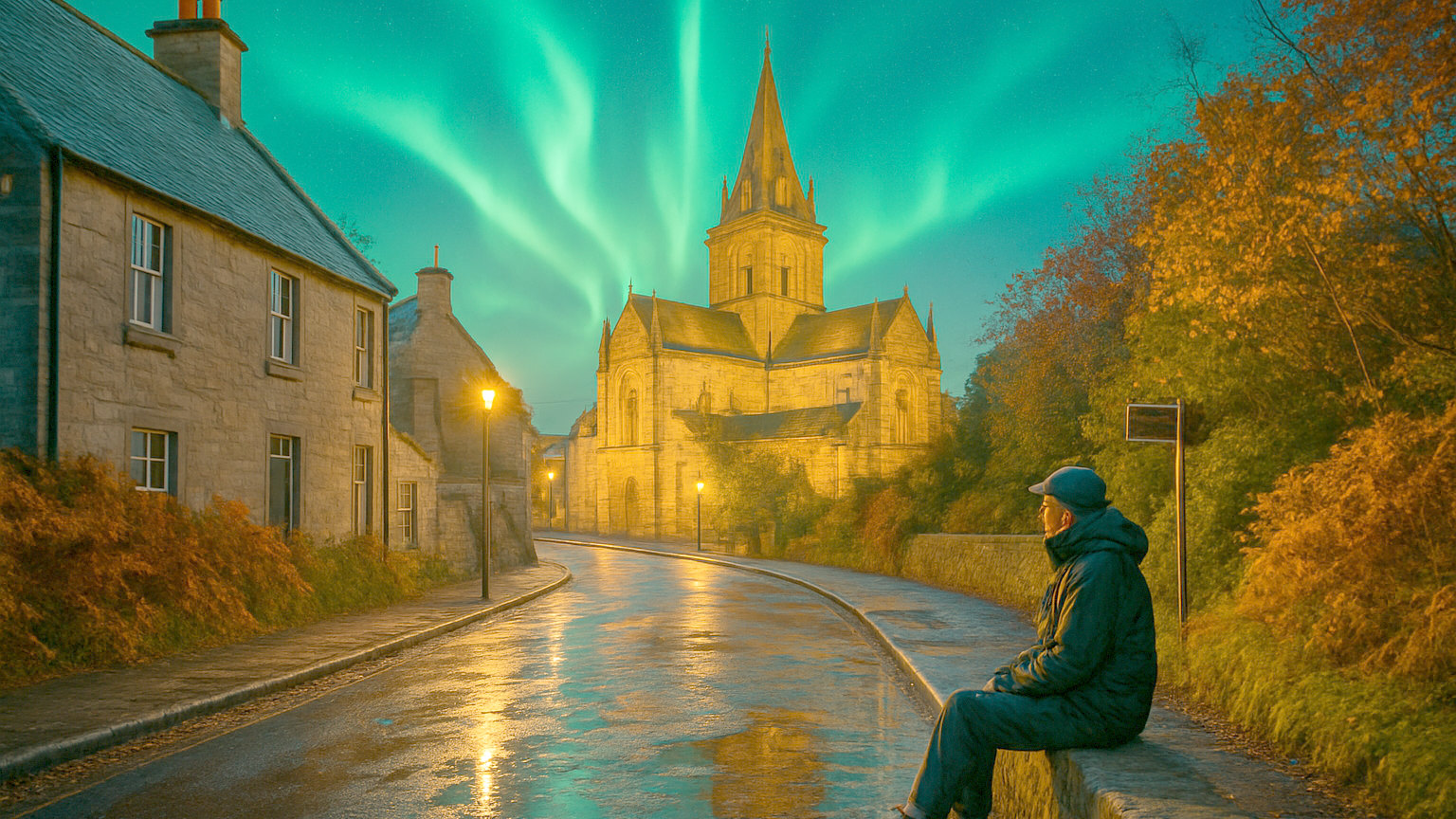
Scotland lies far enough north that the aurora borealis is visible several times each winter, particularly from the northern mainland and the islands. It is not Tromso or Iceland, and displays overhead are uncommon, but a green glow low on the northern horizon is a realistic prospect for anyone in the right place at the right time of year with clear skies and some patience.
What time of year is possible?
From late September to late March. The requirement is darkness, and northern Scotland in summer does not get dark enough at any hour. In Shetland midsummer nights barely dim at all.
The equinoxes in late September and late March are statistically associated with increased geomagnetic activity, which makes those months slightly better than the depths of winter despite the shorter nights available in December.
What conditions are needed?
Three things at once. Geomagnetic activity, measured on an index published by space weather services. Clear skies, which in a Scottish winter is the hardest of the three to obtain. And darkness, meaning after astronomical twilight and preferably away from a full moon.
Missing any one of the three means no display, which is why the aurora rewards flexibility. Visitors who can go out on the clear night rather than the planned night see far more.
Where are the best places to look?
The further north the better. Shetland and Orkney have the highest frequency, followed by Caithness, Sutherland and the north coast around Durness and Thurso. The Moray coast and the Outer Hebrides also do well.
What matters as much as latitude is an unobstructed northern horizon and low light pollution. A north facing beach or a hill with sea to the north is ideal. Displays visible from Shetland as a full arc may show from central Scotland only as a faint glow at the horizon.
Can you see it from the central belt?
Occasionally, during strong geomagnetic storms, the aurora has been photographed from Glasgow, Edinburgh and even northern England. These events are infrequent and unpredictable, and city light pollution washes out anything but the strongest display.
Getting twenty or thirty miles from a city into genuinely dark countryside improves the odds substantially even in the central belt. The Galloway Forest dark sky park in the south west is a good site despite its latitude.
How should you use the forecasts?
Aurora forecasts work on two timescales. Long range predictions based on solar rotation give a few days of notice and are approximate. Short range alerts based on satellite measurements of the solar wind give around twenty to forty minutes of warning and are far more reliable.
The practical approach is to watch the short range alerts, check a satellite cloud forecast, and be prepared to go out at short notice late in the evening. Several alerting services and local groups publish notifications.
What will it actually look like?
Often less dramatic to the eye than in photographs. The human eye perceives little colour in low light, so a display that appears vividly green and pink on a camera may look like a pale grey or faintly green arc in person, sometimes with visible movement or rays.
Strong displays are genuinely spectacular without a camera. Weaker ones are still worth seeing but expectations set by processed photographs lead to disappointment.
What should you take?
Far warmer clothing than you think, since standing still on a north facing coast in February is very cold. A red torch to preserve night vision. A camera capable of long exposures on a tripod, since even a modest camera set to several seconds will record far more than the eye sees.
Most importantly, take time. Displays can build and fade over hours, and the people who see the best of it are usually those who stayed out after the first faint glow rather than those who checked once and went inside.
Treat any sighting as a bonus rather than the purpose of the trip. Winter Scotland has plenty else to offer, and a week planned around the aurora alone can end in cloud.