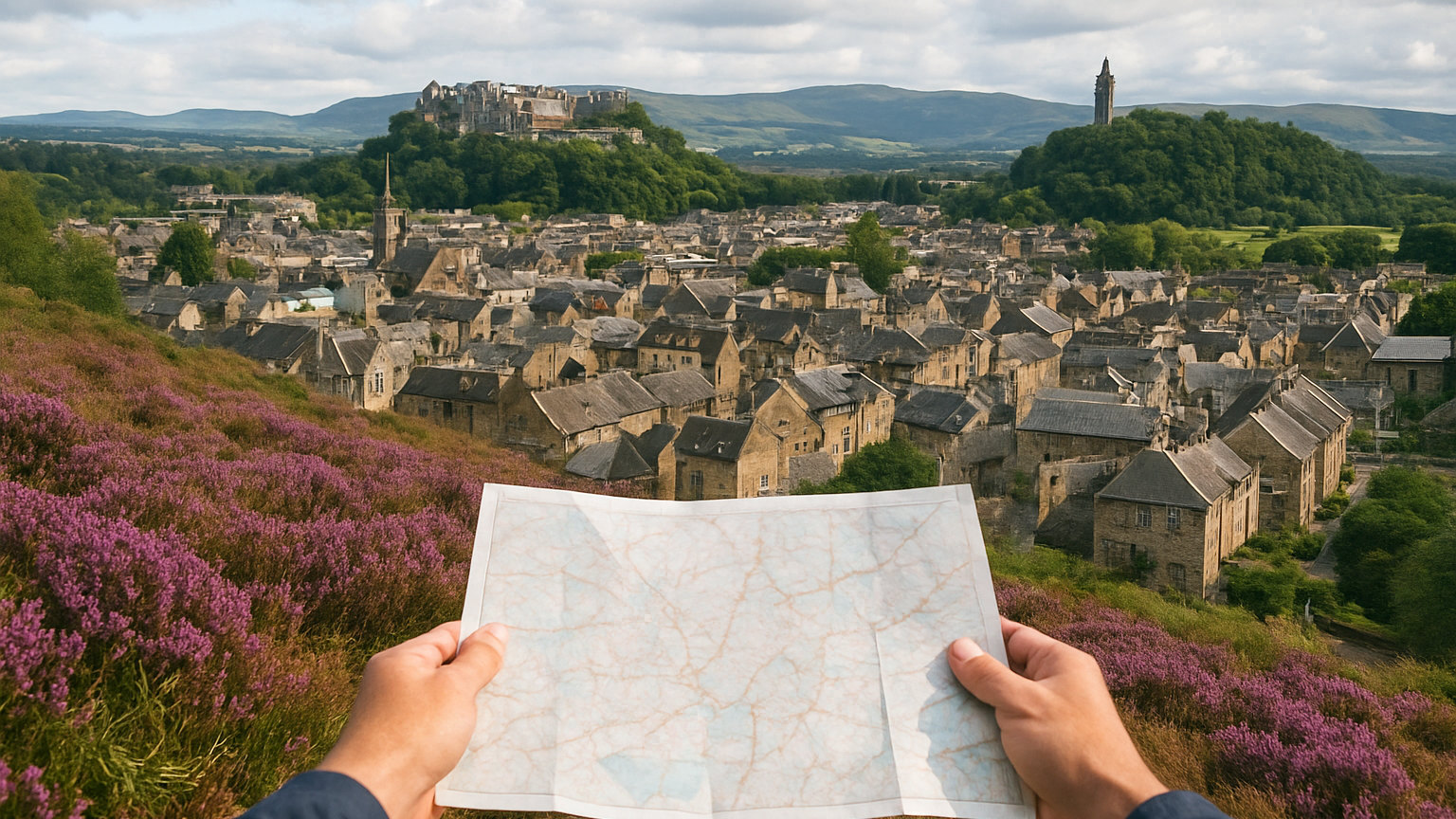
Stirling occupies the narrowest point of central Scotland, where the Highlands meet the lowlands and the Forth was once crossable at a single bridge. Whoever held it controlled movement between north and south, which is why two of the most consequential battles in Scottish history were fought within sight of the castle.
What is at the castle?
One of the largest and most important castles in Scotland, on a volcanic crag above the town, with royal apartments restored to their sixteenth century appearance including reproduction tapestries woven over many years.
The Great Hall, the chapel and the palace are all open, and the view from the walls explains the whole of central Scotland at a glance.
What is the old town?
A steep street running down from the castle past a church where a coronation took place, a seventeenth century townhouse and the old jail, with defensive walls surviving in places.
It is small, walkable in an hour and considerably quieter than equivalent streets in Edinburgh.
What happened at Bannockburn?
A battle in 1314 in which a Scottish army defeated a much larger English force, securing Scottish independence for a period and becoming central to national memory.
A visitor centre south of the city covers it using digital reconstruction, since the exact site is partly built over and the ground itself shows little.
What is the Wallace Monument?
A Victorian tower on a crag north of the city commemorating a leader of the earlier resistance, reached by a steep climb and then a spiral stair of two hundred and forty six steps.
The view from the top is exceptional. The monument holds a sword attributed to him and displays on Scottish history.
What else is in the city?
The Church of the Holy Rude, where a coronation took place and which still shows damage from the civil war. The old bridge over the Forth, and Cambuskenneth Abbey across the river.
The university sits beside a loch below the Ochil Hills and its campus is open to walk through.
What is nearby?
The Trossachs and Loch Lomond to the west, reachable in under an hour, with the Duke's Pass and Loch Katrine among the best short drives in Scotland.
The Ochil Hills immediately north, Doune Castle a short drive away, and the Falkirk area with its enormous horse head sculptures and a rotating boat lift.
How do you get there?
By train, with Glasgow and Edinburgh both under an hour, and services north to Perth and the Highlands.
The city sits at the junction of the main routes through central Scotland, which is the point of it, and is easily reached by road from either direction.
Is it a good base?
An excellent one. Both major cities are within an hour, the Trossachs and Loch Lomond are close, and accommodation is considerably cheaper than in Edinburgh.
For anyone wanting to see central Scotland without paying capital prices, it is the obvious choice.
Where should you eat?
The old town and the area below the castle for pubs, and the modern centre for a reasonable range of restaurants.
It is a university city, which supports more places than the resident population alone would.
How long do you need?
One night covers the castle, the old town and the monument. Two or three if using it as a base for the Trossachs and the two cities.
The castle deserves at least half a day on its own, which visitors treating Stirling as a stop between cities rarely allow.
What about the wider Forth valley?
The area between Stirling and Edinburgh holds a great deal, including a rotating boat lift connecting two canals, two enormous horse head sculptures beside the motorway, and the remains of the Antonine Wall, the northernmost frontier of the Roman empire, which crosses central Scotland and forms part of a transnational World Heritage Site.
One final practicality: the castle and the monument both involve substantial climbs, the castle on cobbles and the monument on a spiral stair. Neither is suitable for anyone who would find that difficult, though the castle has better provision than the tower does.