Bath is built over the only hot springs in Britain, which the Romans developed into a bathing complex and the Georgians rediscovered as a fashionable spa. The result is a compact city of honey coloured stone, laid out in crescents and circuses, and a World Heritage Site in its entirety.
What are the Roman Baths?
The most complete Roman remains in Britain, centred on a bathing complex fed by a spring that still delivers water at a constant temperature, with a temple, a sacred spring and an extensive museum.
The water is untreated and cannot be entered. Allow at least two hours, book ahead, and go at opening or in the last hour to avoid the worst of the crowds.
Can you actually bathe?
Yes, at a modern spa in the city using the same thermal water, including a rooftop pool looking across to the abbey, which is the single most distinctive experience Bath offers.
Book ahead, particularly for weekends and evenings, and note that it operates age restrictions.
What is the Georgian architecture?
The reason the city looks as it does. The Royal Crescent, a sweep of thirty houses behind a uniform facade, and the Circus, a ring of townhouses in three segments, are the set pieces.
Both are free to walk to and look at. One house on the Crescent is open as a museum furnished to the period, which is worth doing to understand how these buildings actually worked.
What is the abbey?
A late medieval church on the site of much older foundations, with fan vaulting, an unusual west front showing angels climbing ladders, and a tower tour that goes behind the clock face and onto the roof.
It sits directly beside the Roman baths, which makes the two an obvious pairing.
What is the Austen connection?
She lived here for several years and set substantial parts of two novels in the city. The Georgian streets, assembly rooms and pump room she knew survive largely intact.
A centre in the city covers her time here. The evidence suggests she did not much enjoy living in Bath, which the novels treat with a good deal of irony.
What else is worth seeing?
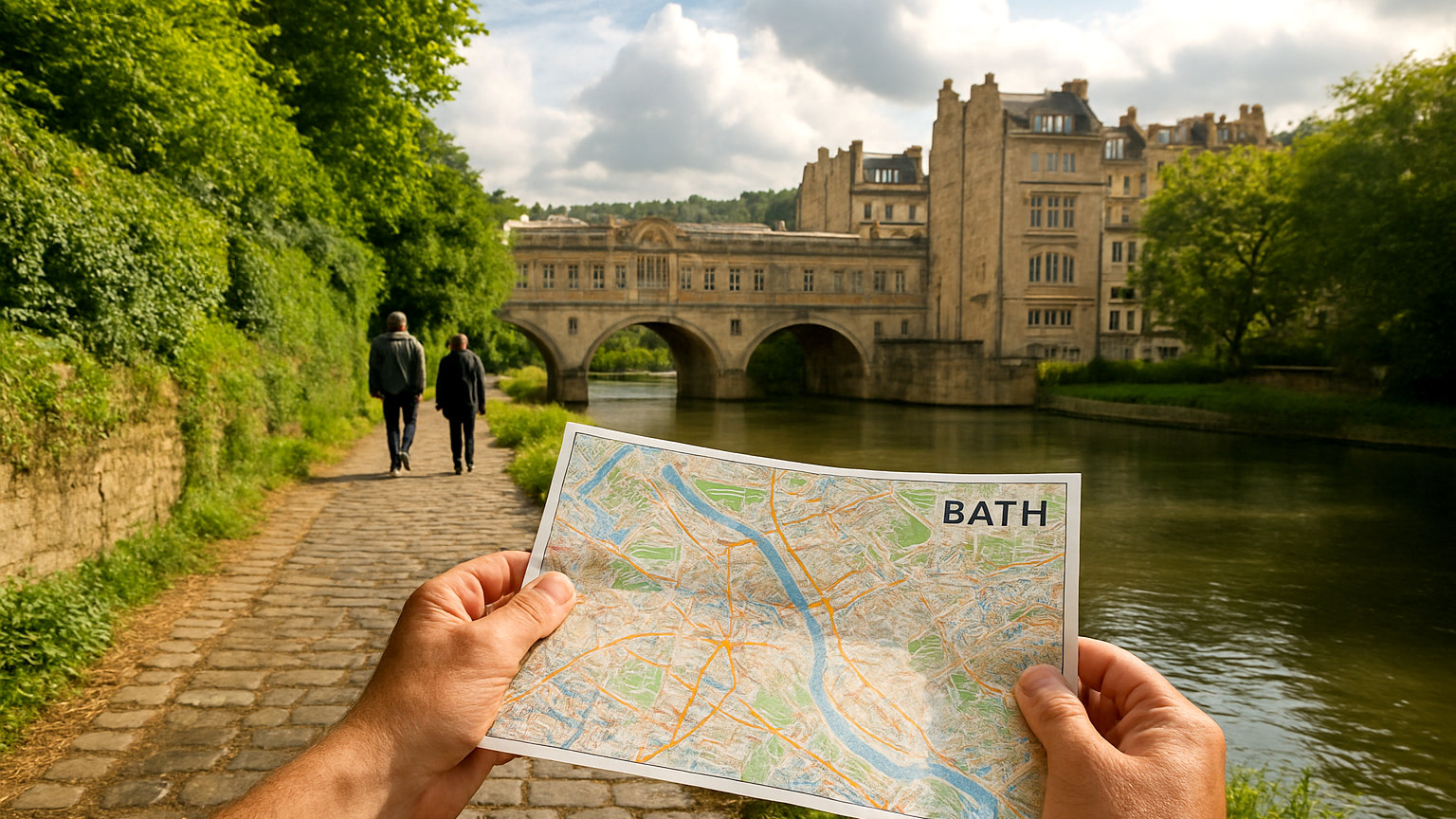
Pulteney Bridge, lined with shops on both sides, and the weir below it. The Holburne Museum at the end of the street. The Museum of Bath Architecture, which explains how the city was built.
Prior Park, a landscape garden on the hillside with a Palladian bridge and a view down over the city.
How do you get there?
By train from London in around ninety minutes and from Bristol in fifteen. The station sits at the edge of the compact centre.
A car is unnecessary and unhelpful, since parking is limited and expensive and everything is within a twenty minute walk.
How busy does it get?
Very, in summer and at weekends, with the central streets crowded from mid morning. It is among the most visited small cities in England.
Midweek and out of season are considerably better, and the city looks its best in low winter sun on the stone.
Where should you eat?
A good range for the size, with several notable restaurants and a strong bakery and cafe scene. The city is expensive by regional standards.
Walking ten minutes out of the centre, particularly towards Walcot Street, improves both price and character.
How long do you need?
Two nights covers the baths, the abbey, the Georgian set pieces and the spa without hurrying. Three allows a day in the surrounding countryside.
Bristol is fifteen minutes away, the Cotswolds begin to the north east and the Mendips and Cheddar Gorge lie south.
What about the surrounding countryside?
The Cotswolds begin immediately north east, with Castle Combe and Lacock both within half an hour and both among the most filmed villages in England. The Mendips, Cheddar Gorge and Wells lie south, and the Kennet and Avon canal runs east from the city with a towpath walk to a spectacular flight of locks at Devizes.