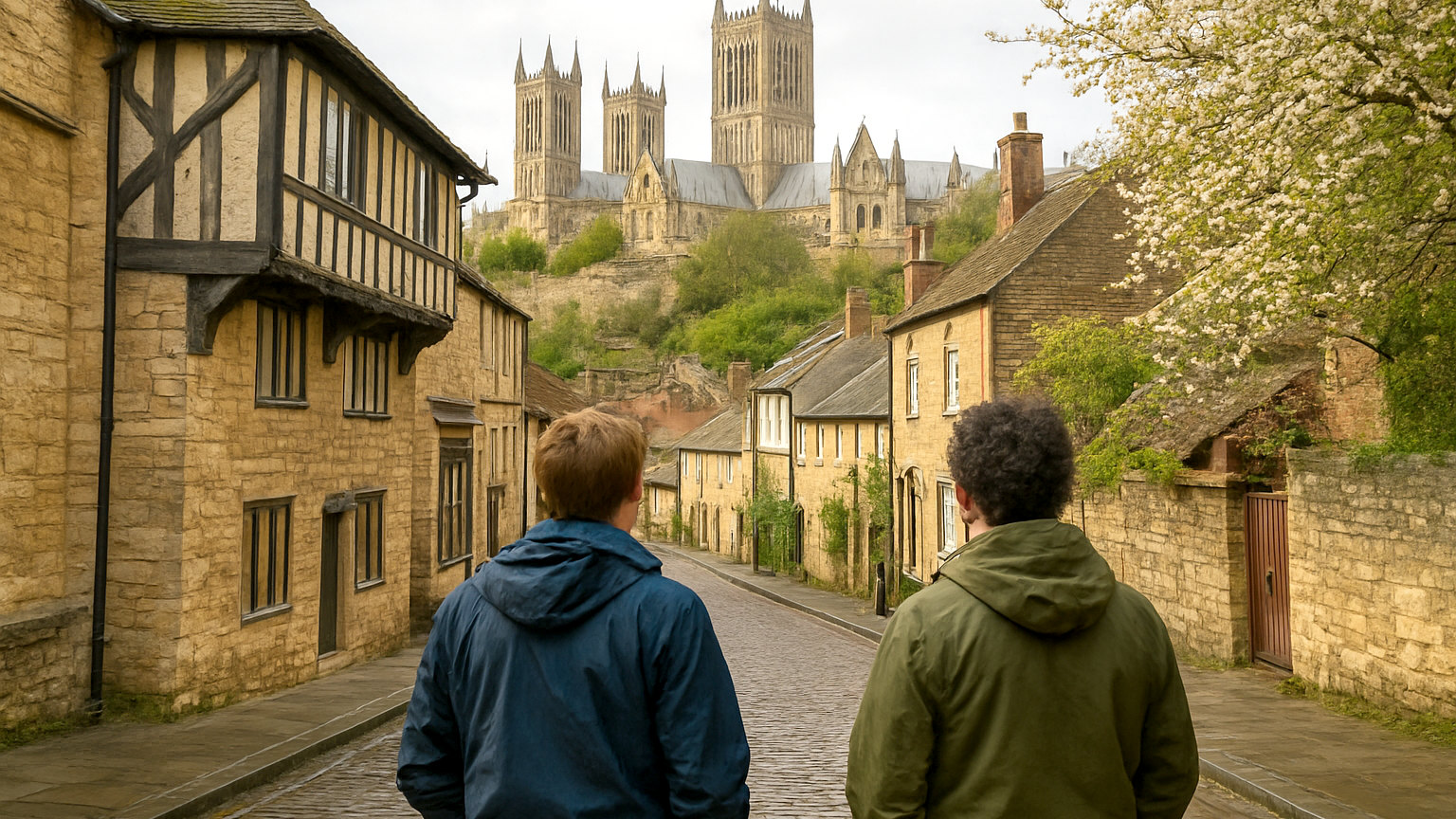
Lincoln sits on a limestone ridge above a flat county, with the cathedral on the crest visible for thirty miles across the fens. The upper city holds the cathedral, the castle and the medieval quarter, and a famously steep street connects it to the modern centre below.
What is the cathedral like?
Enormous. It was for over two centuries the tallest building in the world, before its central spire collapsed in a storm in the sixteenth century, and it remains among the finest Gothic buildings in Europe.
Look for the carved angel choir, the Lincoln imp high on a column, and the west front. Tower and roof tours run and are worth taking.
What is at the castle?
A Norman castle with a complete wall walk around the ramparts, giving views over the city and the county, and two former prisons within the walls.
It holds one of only four surviving original copies of Magna Carta, displayed in a purpose built vault alongside a copy of the Charter of the Forest.
What is Steep Hill?
A cobbled street climbing from the lower city to the cathedral quarter, steep enough to require handrails, lined with independent shops, bookshops and cafes.
It is regularly named among the best streets in Britain and it is a genuine climb. Buses run up for anyone who would rather not.
What is the Bailgate quarter?
The area around the cathedral and castle, with Roman remains including a gate still carrying traffic, medieval houses and the best of the city's eating.
Circles in the road mark the positions of Roman columns, and a substantial stretch of Roman wall survives nearby.
What Roman remains are there?
Lincoln was a legionary fortress and then a colony for retired soldiers, and the upper city follows the Roman street grid.
Newport Arch at the north end is a Roman gate still in use by vehicles, which is claimed as the only one in Britain.
What is the lower city like?
Modern shopping and the waterfront along a Roman canal and the river, with the university campus beside it and a marina.
It is functional rather than historic, and most visitors spend their time above the hill.
What is nearby?
The Lincolnshire Wolds, a quiet chalk upland designated for its landscape and almost entirely unvisited. The fens to the south and the long empty coast to the east.
Aviation heritage is substantial, since the flat county held a great many wartime airfields, and several museums cover it.
How do you get there?
By train, with direct services from London taking around two hours and connections across the Midlands and the north.
The city is off the main routes by road, which contributes to how quiet it stays.
When should you go?
Any time, though the Christmas market in early December is among the largest in the country and fills the upper city entirely.
Spring and autumn are quiet and the cathedral looks best in low sun on the limestone.
How long do you need?
Two nights, which covers the cathedral, the castle, Magna Carta and the medieval quarter without hurrying.
Accommodation is inexpensive and the city receives far fewer visitors than its cathedral warrants.
What is the cathedral quarter like in the evening?
Considerably quieter than by day, when the coach parties have gone and the upper city belongs to residents. The cathedral is floodlit, the Bailgate pubs are busy and the view from the castle walls at dusk is the best in the city. Staying overnight rather than visiting for a day makes a substantial difference here.
A last practicality: the walk up Steep Hill is genuinely steep and cobbled, and anyone who would find it difficult should use the bus that runs from the lower city to the cathedral quarter rather than attempting it.
What about the aviation heritage?
Lincolnshire held a very large number of wartime airfields and is sometimes called bomber county, with several museums, a memorial and a preserved aircraft that taxis and occasionally flies. The visitor centre at the international memorial near the city covers the crews, including the losses, and is among the more affecting sites in the county.