Britain has around eleven thousand miles of coastline and a national habit of visiting roughly the same fifty beaches. The crowding on a fine August day is real, and it is also almost entirely self inflicted, because the determining factor is not how good a beach is but how easy it is to park at.
What keeps a beach quiet?
Three things: no large car park, no facilities, and a walk of more than about ten minutes from the road. Any beach with all three will be quiet on any day of the year.
The corollary is that quiet beaches require carrying your things further, which is why they stay quiet. That is the whole trade.
How do you find them on a map?
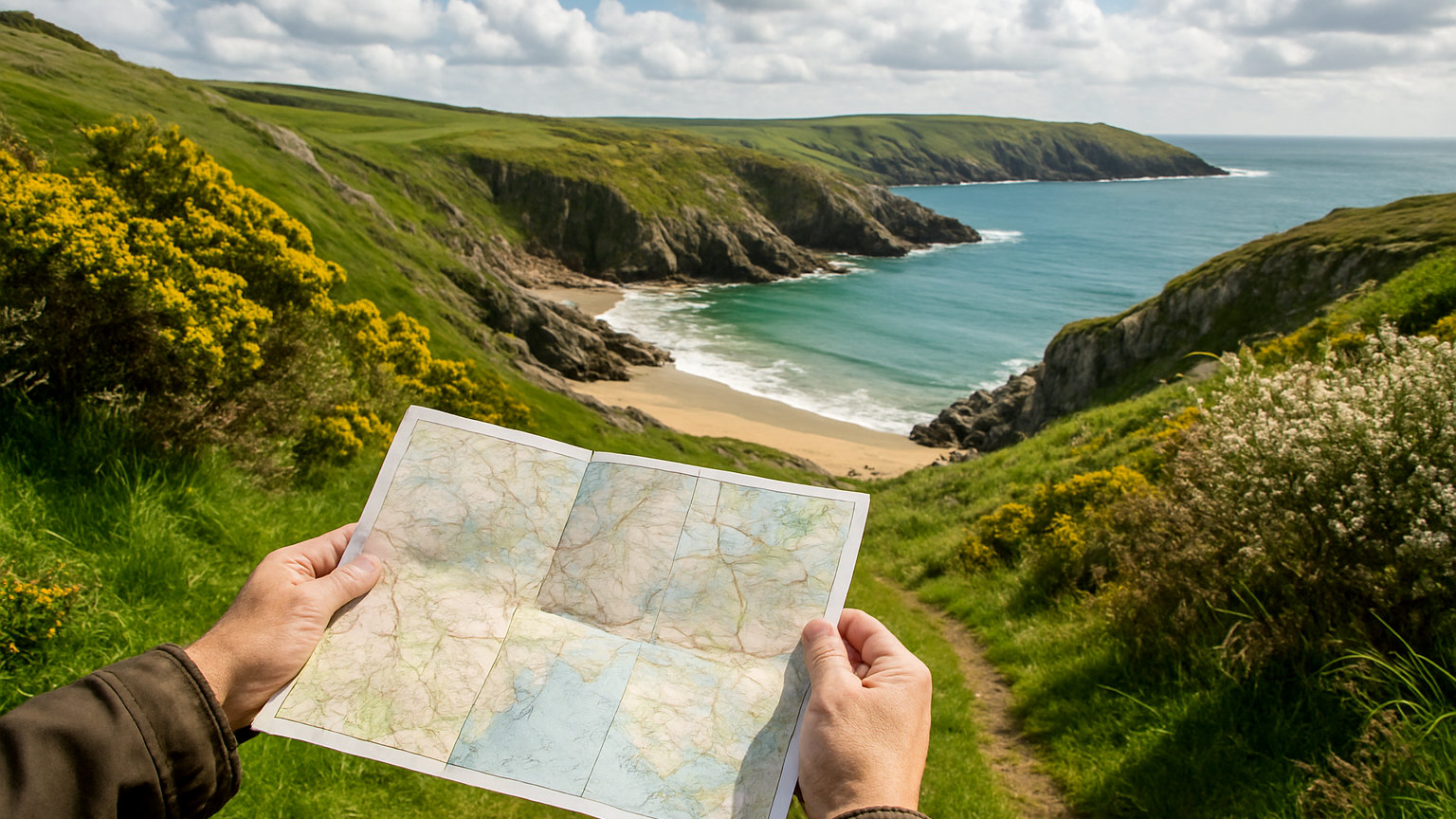
Look at Ordnance Survey mapping along a stretch of coast and find sand with no adjacent car park symbol. Then check whether a footpath reaches it and where the nearest legal parking is.
Satellite imagery taken in summer is the other useful check, since it shows both how full the car parks are and how much sand there actually is at that state of tide.
Which coasts stay quietest?
Northumberland, which has superb beaches and a fraction of the visitors of the south west. Galloway and the Scottish west and north coasts, which are close to empty even in August.
The Suffolk and Lincolnshire coasts, west Wales beyond the main resorts, north Devon around Hartland, and much of Northern Ireland outside the Causeway coast.
Does the time of day matter more than the place?
Frequently, yes. Even the busiest beach is quiet before nine in the morning and after five in the afternoon, and the light is better at both ends.
Car parks that are full by ten have spaces at four. For anyone willing to shift their day, the crowding problem largely disappears without changing destination at all.
How far do you have to walk?
Usually less than people think. A ten to fifteen minute walk from a car park removes the overwhelming majority of visitors, because most families are not going to carry a windbreak, a cool box and a toddler that far.
On long beaches, simply walking for ten minutes along the sand away from the access point achieves the same thing.
What are the trade offs?
No lifeguards, which matters if you intend to swim. No toilets. No shop, no ice cream and no rescue if something goes wrong quickly.
Quiet beaches are also more likely to have tricky access, unstable cliffs above them and cut off risk at high tide, all of which need checking before you commit to a descent.
What should you check before going?
The tide, since many small coves disappear entirely at high water and some cut off the return route. Where the legal parking is, since verge parking on coastal lanes is heavily restricted and enforced.
And whether the access path is a genuine right of way. Some beaches shown on maps are reached only across private land.
Is the east coast underrated?
Considerably. The North Sea is colder than the Atlantic, which puts people off, but the east coast is drier, sunnier and far less crowded, and the beaches at Bamburgh, Holkham, Southwold and Holy Island are as good as anything in the south west.
For a family that will spend most of the day on sand rather than in water, the temperature difference matters much less than the space.
What is the simplest tactic?
Go to the beach next to the famous one. Almost every well known British beach has a neighbour a mile along the coast with a fraction of the people and frequently identical sand.
Walk ten minutes from wherever you park, and go before nine or after four. Those two habits solve most of the problem without any research at all.
Finally, be realistic about what quiet means in August. A beach with twenty people on it is quiet by British summer standards, and holding out for an empty one can mean driving past several perfectly good options. Twenty minutes of walking usually beats an hour of searching.