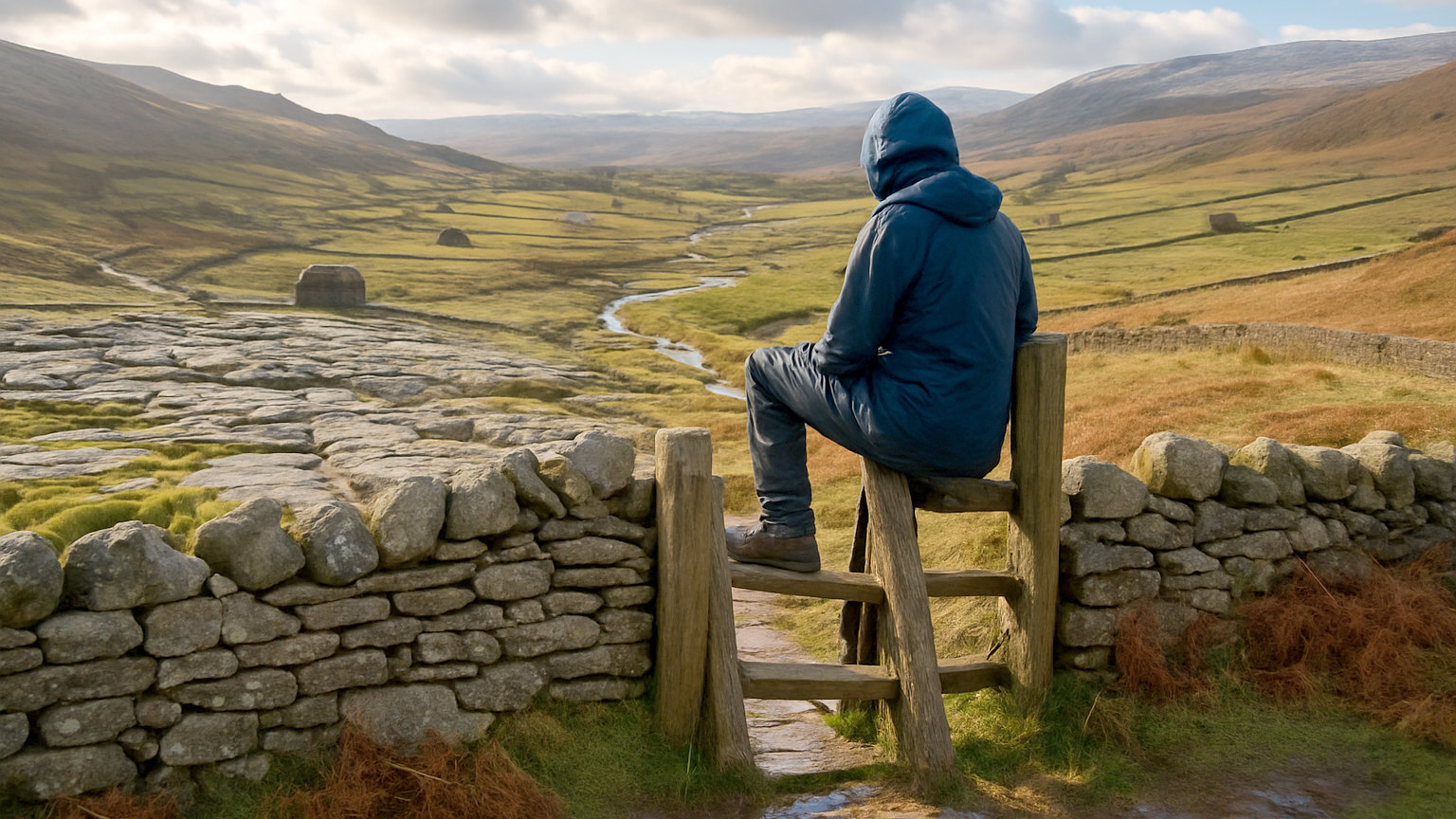
The Yorkshire Dales are a limestone upland of green valleys divided by high moor, threaded with drystone walls and dotted with field barns in a pattern found almost nowhere else. Beneath them lies one of the most extensive cave systems in Britain.
What is at Malham?
A curving limestone cliff nearly eighty metres high, with a limestone pavement of fissured blocks along the top, and a gorge at Gordale Scar a short walk away.
The pavement is spectacular and the fissures are deep enough to break a leg, so walk it carefully. It is the most visited spot in the park and is best early.
What is the Ribblehead viaduct?
A twenty four arch viaduct carrying the Settle to Carlisle railway across an exposed moor, built in the 1870s at considerable cost in workers' lives, with a shanty town on the site.
Trains still cross it several times a day on a working main line, and the line is among the finest railway journeys in England.
What are the Three Peaks?
Pen y ghent, Whernside and Ingleborough, traditionally walked in a single circuit of around twenty four miles with substantial ascent, usually within twelve hours.
It is popular to the point of causing erosion, and organisers ask walkers to stick to repaired paths, avoid large unregistered groups and consider spreading the peaks across separate days.
Which waterfalls are worth seeing?
Aysgarth Falls, three sets of stepped falls on the Ure with easy access. Hardraw Force behind a pub in Hawes, reached through the premises and claimed as the highest unbroken fall above ground in England.
Ingleton has a waterfalls trail through wooded gorges, charged for and among the best short walks in the park.
What is underground?
An enormous cave system, with show caves at Ingleton, Clapham and Stump Cross open to visitors on walkways.
Wild caving requires equipment, training and a club, and several systems flood extremely fast after rain. It should never be attempted casually.
Which dales should you visit?
Swaledale in the north, narrow and quiet, with hay meadows and field barns at their most concentrated. Wensleydale, broader and greener, with the cheese and a castle at Middleham.
Wharfedale in the south with Bolton Abbey and the Strid, a dangerous narrowing of the river that has drowned people and should be viewed from well back.
What about the villages?
Grassington, Reeth, Hawes, Settle and Kettlewell all make good bases, each with pubs, shops and walking from the door.
Hawes has a working rope maker and a creamery, and Reeth sits at the junction of two valleys with a large green.
Can you get there by train?
Yes. The Settle to Carlisle line runs through the western dales with stations at Settle, Horton, Ribblehead, Dent and Garsdale, several of them useful for walks.
Skipton and Ilkley have services from Leeds and Bradford with buses onward into the park.
When is best?
June for the hay meadows, which are among the last traditional meadows in England and are at their peak before cutting. Autumn for colour and low light.
Winter is quiet, cold and beautiful, with waterfalls at their most impressive after rain.
What should you be careful of?
Limestone pavement fissures, unstable ground around old lead workings, rivers rising rapidly after rain and the moorland weather, which changes fast.
Old mine shafts in the northern dales are frequently unfenced and hidden by vegetation, so stay on paths in that country.
How long do you need?
Three or four nights in one dale, walking from the door, which is how the park works best.
Trying to cover several dales by car means driving over high passes between them and seeing less than staying put.
What about the field barns?
Scattered across the meadows in their hundreds, particularly in Swaledale, these small stone barns each served a single field, storing hay and wintering a few cattle. The pattern of barns and walls is unusual anywhere in Europe and is protected as a historic landscape, though many barns are now redundant and expensive to maintain.